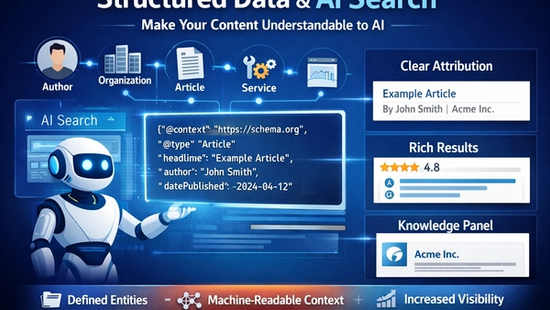
Structured Data in the Age of AI Search: Why It’s No Longer Optional
Published: 2/19/2026
Search has changed.
We’re no longer optimizing only for blue links on a results page. We’re optimizing for AI systems that summarize, extract, compare, and recommend content directly inside generative interfaces.
In this environment, structured data is not a “nice-to-have.” It’s foundational infrastructure.
Search Is Now Entity-Driven, Not Keyword-Driven
Modern search engines do not just index pages — they map entities.
They try to answer:
- Who is the author?
- What organization is behind this?
- Is this an article, a product, or a service?
- When was it published?
- What topic does it belong to?
Without structured data, the search engine must infer these relationships. In an AI-driven search ecosystem, inference introduces ambiguity. Ambiguity reduces visibility.
Structured data removes ambiguity.
AI Search Systems Need Machine-Readable Context
AI search models do not “read” pages the way humans do. They parse signals.
Structured data (Schema.org JSON-LD) gives AI systems:
- Explicit content type (Article, Service, Product, Organization)
- Clear author attribution
- Defined publish dates and updates
- Hierarchical relationships (organization → article → author)
- Canonical URLs and primary images
This allows generative systems to:
- Confidently summarize content
- Attribute sources correctly
- Select your page as a citation
- Display enriched results
Without these signals, your site becomes harder to trust and harder to surface.
Generative Search Prioritizes Structured Signals
AI-powered search experiences (like Google’s generative search results and conversational interfaces) rely on structured metadata to:
- Extract headlines accurately
- Associate images with content
- Understand service offerings
- Recognize brand authority
- Determine freshness
If your page lacks structure, AI must guess.
When AI guesses, it often prefers competitors who provide cleaner, explicit schema markup.
Structured Data Strengthens Brand Entities
In today’s search landscape, brands compete at the entity level.
Properly implemented structured data connects:
- Organization → name, logo, URL, social profiles
- Article → headline, author, datePublished, image
- Person → author identity
- Service → description, areaServed, provider
This reinforces your presence in knowledge graphs.
Strong entity signals improve:
- Brand recognition in AI answers
- Eligibility for rich results
- Authority in topic clusters
AI systems favor well-defined entities.
Rich Results Are Now Strategic, Not Cosmetic
Structured data enables:
- Article rich results
- FAQ dropdowns
- Breadcrumb trails
- Sitelinks search box
- Knowledge panels
These are no longer cosmetic enhancements.
They increase:
- Visual prominence
- Click-through rate
- Perceived credibility
In AI-influenced search, credibility signals matter more than ever.
Structured Data Improves Attribution in AI Summaries
One of the biggest risks in AI search is invisibility.
If your content is summarized but not attributed, your brand loses exposure.
Clear schema helps AI systems:
- Identify your organization
- Associate content with your domain
- Attribute authors correctly
- Link back to canonical sources
Structured data increases the probability of proper citation.
It’s Low Effort, High Leverage
Compared to backlinks, domain authority campaigns, or large-scale content production, structured data is:
- Technically straightforward
- Lightweight to maintain
- Fully under your control
- Immediate in impact
It does not guarantee ranking improvements, but it enhances eligibility, clarity, and discoverability.
In AI search environments, clarity is competitive advantage.
The Future Is Structured
Search is moving toward:
- Conversational interfaces
- Multi-modal understanding
- Knowledge graph expansion
- AI-driven summarization
- Entity-based retrieval
Websites that remain purely HTML-based without structured signals are increasingly opaque to machines.
Websites with explicit schema become machine-readable knowledge nodes.
That distinction will only grow more important.
Final Thought
In the age of AI search, structured data is not about gaming algorithms.
It is about making your website understandable to intelligent systems.
If search engines and AI models cannot clearly interpret what your content represents, your visibility is limited.
Structured data ensures your content is:
- Interpretable
- Attributable
- Competitive
- Future-ready
For modern webmasters, that makes it essential infrastructure — not optional SEO decoration.